



Since Google decided to support showing emojis in search results, many SEO agents have used this as a kind of ‘Holy Grail’ that, according to them, will multiply your CTR and make you gain more visits. But is this true? Let’s take a look.
If you’re not up to date with what this “technique” is, I’ll tell you that it basically consists of using emojis to catch the visitor’s attention and make them click on our result in Google.
Used wisely, the use of emojis is positive. But be careful, not all projects are suitable for it.
Emojis in SERPs are good
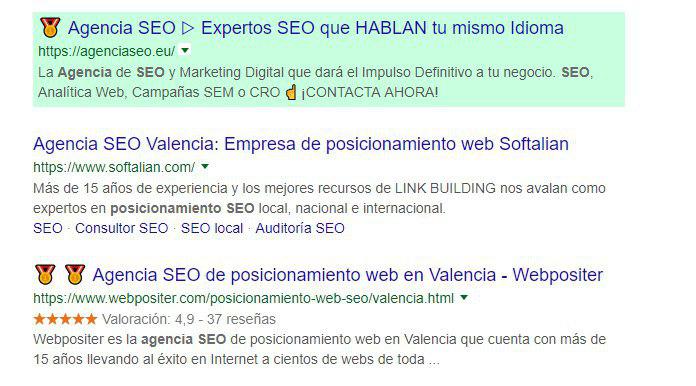
The first answer that comes to mind is that the use of emojis in SERPs is a good thing. And it is because, when used well, we can appeal to the visitor’s emotional side. An example of good use is the one made by Webpositer, an SEO agency that, thanks to these medals they’ve placed in the meta title, instill confidence in the user. As you can see, they’re not aggressive at all and fit perfectly in this particular project, given that the target audience is receptive to it.
Some of these symbols can play an important role in how we project our brand image. Being a shoe store and using the corresponding icon may be a good idea.
Abuse leads to losing positions
But as with everything in life, the use of emojis to boost CTR is a double-edged sword. Just like with AdSense ads, humans have gotten used to seeing these signals in SERPs, especially since some people use them without any coherence and end up abusing them. And where does this lead us? Well, to good content on the web being buried due to this ‘voracious hunger’ to appear first in search engines.
Basically, some results look more like a ‘fair’ than something descriptive. And you have to understand that emoticons are part of the current language and should be used naturally, not always for dynamics, and even less to bury the main message of your meta description. Don’t forget that in a query or search, the meta description is the part where you can enhance your title with additional information, that’s where you can “sell” yourself to your potential customer or reader.
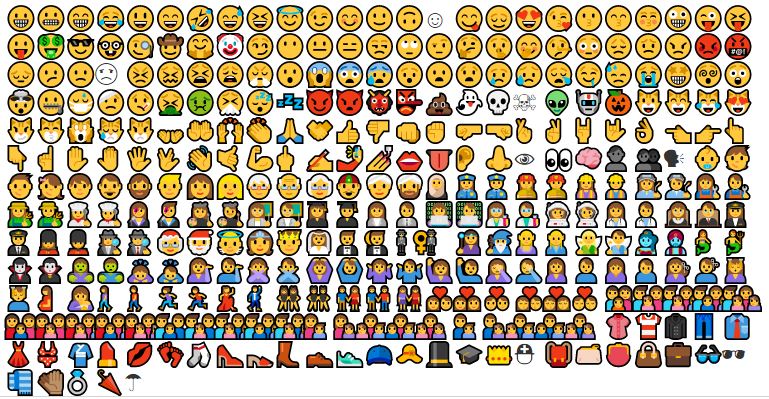
Some emojis that express emotions.
Emojis in media
There’s nothing that gives a reader a worse impression than finding a search result full of emoticons, all of them meaningless and designed to tell them what to do. I would never recommend this type of practice on a news website, as apart from what I’ve mentioned earlier, you also carry that icon to Twitter and Open Graph cards.
Moreover, now that media websites are fighting to gain ground in the new Discover section of Android, emojis are just additional characters that limit the visibility of your title. Remember that a good title and meta description are more powerful than putting ice cream icons. Moreover, putting them doesn’t guarantee that your CTR will increase, it will always depend on the project and how coherent it is to use them.
The 4th, 5th, and 6th pages are full of results with emojis in SERPs. It’s not a miraculous technique.
As with everything, there are many variables to consider, so you have to study whether adding them to the URL you want to boost and the result you’re looking for makes sense. Using them without a strategy “just because they say it on the Internet” doesn’t help. In some experiments, I’ve seen how the traffic from these decreased to the point where it pushed me to the third page, a URL that was well-positioned on the first page and receiving constant traffic.
However, I insist that, when used well, emojis in SERPs are a powerful tool to improve your message. If you want to use them, I recommend visiting Emojipedia and choosing the ones that best fit your content; remember that you can use them not only in search boxes but also within your texts.